Duty to intervene against cruelty
Black BeautyDuty to intervene against cruelty is the principle that concern for vulnerable animals must become action: people who can oppose mistreatment should not dismiss it as someone else’s business. The narrative traces that responsibility from household teaching and public persuasion to intervention and testimony, making non-interference itself a moral choice.
A Principle Practised at Home
At Birtwick, kindness toward animals is part of the household’s conduct, not merely a private sentiment. Squire Gordon and his wife are described as friends to creatures who are oppressed or ill-used, and their servants follow their example. Children known to mistreat animals hear about it from the Hall, establishing that cruelty is treated as a matter for the community rather than an issue only an animal’s owner may address.
That ethic also takes the form of persistent public persuasion. Squire Gordon and Farmer Grey have worked for more than twenty years to eliminate the Bearing rein from cart horses; in their district, its use has consequently become uncommon. When Squire Gordon’s wife sees a heavily laden horse with its head strained upward, she may stop the carriage, get out, and explain to the driver why the practice is both foolish and cruel. Her response combines practical reasoning with an appeal to the driver’s responsibility.
A remembered school lesson gives the principle a sharper moral formulation. James Howard recalls confronting a boy who had harmed flies, then showing the injured creatures and their detached wings to the schoolmaster. The schoolmaster treated cruelty toward the weak as evidence of a person’s moral allegiance, contrasting it with kindness to people and animals. John Manly affirms the underlying point: religious profession is hollow if it does not teach kindness to both. In this recollection, speaking against cruelty is not an optional refinement of character but a test of what a person’s principles mean in practice.
Joe Green’s Intervention
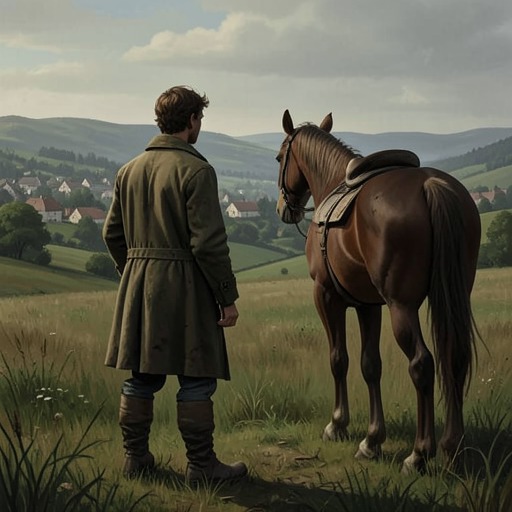
The clearest practical demonstration comes when Joe Green, riding Black Beauty on an errand, encounters a heavily loaded brick cart stuck in deep ruts. The carter continues to flog the two horses despite their inability to move the cart. Joe first tells him to stop, then offers to help lighten the load. When the carter refuses and continues, Joe turns back at a gallop to summon the brick-maker.
Joe explains what he has witnessed and agrees to give evidence if the carter is brought before a magistrate. His choice turns an immediate protest into a report that can be acted upon. John Manly praises him for intervening, explicitly rejecting the excuse that the incident was none of a bystander’s business. Joe’s anger settles into pride at John’s approval, and the episode marks a change in his bearing: he remains gentle, but acts with greater purpose and determination.
The account also follows the intervention into a formal process. Squire Gordon is a county magistrate, and Joe is summoned to his private room to give evidence. He presents his account clearly; the horses’ exhausted condition and signs of harsh treatment support it. The carter is committed to take his trial, though the narration describes a possible sentence rather than confirming a final judgment. The sequence shows how observation, reporting, and testimony can carry concern beyond immediate reproach and into public accountability.
Responsibility Beyond the Stable
Jerry Barker states the principle in broader terms when discussing people who witness wrongdoing. In his view, indifference allows cruelty and oppression to continue; those who can bring a wrongdoer to light should act. He says that he has informed masters about the treatment of their horses and that some have thanked him. His account presents intervention not as a single dramatic rescue but also as repeated, practical communication between witnesses and those able to respond.
Across these examples, the duty is shaped by both capacity and circumstance. The people who intervene do not all wield the same authority: one persuades a driver, Joe reports what he has seen and offers testimony, and Jerry passes information to horse owners. What unites their actions is the refusal to treat another creature’s suffering as irrelevant merely because someone else caused it. The principle thus links kindness to responsibility, and private moral conviction to public action.